

You Can Reverse Lactose Intolerance By Eating More Dairy, Not Less
13 things I learned from a gut health scientist, including why "just cut it out" might be the worst advice you've ever followed.

Lactose intolerance can be reversed — with more dairy, not less.
Everything we've been told about intolerance is "remove the trigger." But what if you give your gut more of what it's supposedly reacting to, and it can relearn how to handle it?
That’s the finding that stuck with me most from this conversation.
Consider this: almost everything we’re taught about discomfort is “remove the source.” Something in your gut reacts badly to a food, so you cut the food. Something in your life causes friction, so you cut the friction. We’ve built an entire industry, set to be worth $8.5 trillion next year, on the idea that the correct response to discomfort is subtraction.
Jordan’s research says the opposite can be true. Give your gut more of what it’s reacting to, in the right dose, at the right pace, and it can relearn how to handle it. The intolerance wasn’t a life sentence. It was a system that had gone untrained. This isn’t universal; in many cases this won’t work, but this angle is less spoken about.
I recognise that pattern outside of digestion, too. I came out of the modelling industry having learned the exact opposite lesson, that the way to deal with anything uncomfortable was to remove it. Cut the calories. Cut the softness. I did “everything right” by that logic, and it made me sicker, not healthier, because I was subtracting my way toward a body I could never actually trust.
The truth, in guts and in everything else, seems to be closer to this: avoidance doesn’t build tolerance. Exposure does, the right amount, on purpose, over time.
So here’s a question worth sitting with: what have you cut out of your life that you should actually be doing more of, not less?
Here’s what I learned talking to him — some of it his, some of it mine, sharpened in the conversation
🎧 Listen to Live Well Be Well: Eat More Kiwi, Use a Poop Stool & Don't Use Mouthwash - Top Gut Scientist
My partners 💛
Nowatch, the world's first aware-able.
I have been wearing Nowatch for a full year (as of today!) and perfectly fitted for today’s episode.
They are the No. 1 tracker for nervous system regulation.
Non-addictive tech that will support you, not deplete you.
15% off with code LWBW15 at www.nowatch.com
🧠 PULSETTO is a vagus nerve device I have been using that supports your stress and sleep
Try it HERE or use my coupon code SARAHANN at checkout. There is also a
30-day money-back warranty. with code SARAHANN.
1. Lactose intolerance can be reversed, with more dairy, not less.
Give people with confirmed lactose intolerance two weeks of daily live yoghurt, then retest them, and their symptoms improve. Eating more fermented dairy retrains the gut to break lactose down again.
Related, if you’ve seen it online: cow’s milk protein comes in two types, A1 and A2. A1 releases a peptide (BCM-7) that’s been proposed to cause gut discomfort separate from lactose entirely, which is why some “lactose intolerant” people tolerate A2 milk (Jersey cows, sheep, goats) just fine. For most people it’s not worth worrying about; the evidence isn’t strong enough to indict A1 broadly, and A2 milk mostly just costs more.
2. Your brain can manufacture a food intolerance out of nothing.
eople who believed they were gluten-sensitive were given two muffins — both secretly gluten-free — and told that one of them contained gluten. They got sick after eating the one they were told had gluten. It didn't. This is the nocebo effect — the evil twin of placebo. If believing a food is harmful can make you feel sick, the same logic works in reverse: believing you've removed a harmful food can make you feel genuinely better, whether or not that food was ever actually the problem.
3. Trying too hard to fix your gut can be exactly what breaks it.
This is the question I actually opened the episode with, and I still think it's the one that matters most: can the optimisation itself — the supplements, the eliminations, the stacking of protocols, be the thing doing the damage? His answer, again and again, was yes. Cutting gluten and dairy "to be healthy" removes food your gut bacteria were relying on.
4. Mouthwash may be raising your blood pressure.
Bacteria in your mouth convert dietary nitrates into nitric oxide, which relaxes blood vessels. Antiseptic mouthwash kills those bacteria, and studies have found blood pressure rising to levels seen in people at heightened cardiovascular risk. Oil pulling, using coconut oil to help rinse your mouth, seems to be the ‘healthier’ option.
5. Most probiotics on the shelf are fake
This is the most confusing area for most: which probiotics actually work? If the label doesn't list a strain identifier after the bacteria's name, it's not an evidence-backed probiotic. And bigger doesn't mean better; a 1-billion-CFU product with the right strain beats a 100-billion-CFU one without it. Strain-specific is the way to go.
This is a free resource to help: tummymot.com, unbiased probiotic/prebiotic/supplement reviews; no companies pay to be listed.
6. Modern toilets fight your anatomy.
A muscle called the puborectalis only fully releases when your knees are above your hips, the squatting position most of the world still uses. A footstool fixes it in seconds.
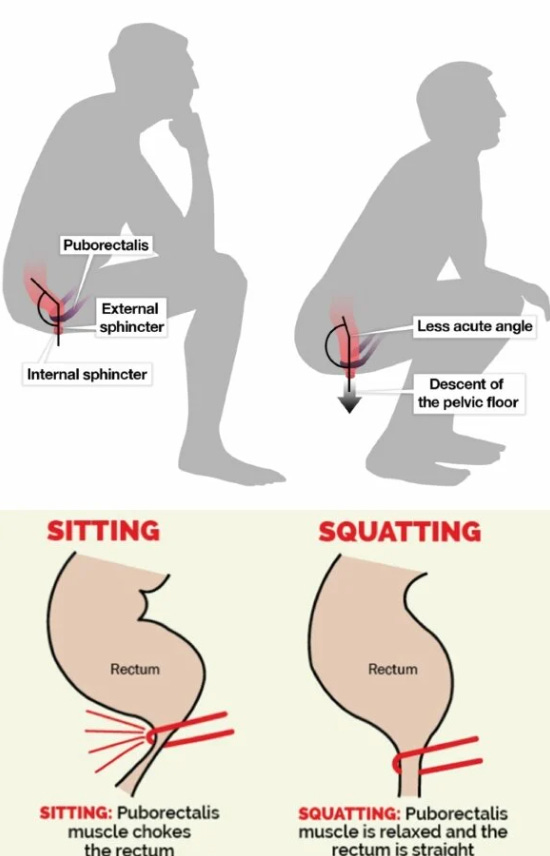
7. The psyllium jelly — a "one wipe guarantee."
His words…can’t quite believe I just wrote that.
This is the thing that already went viral on Jordan’s socials.
Three heaped teaspoons of whole psyllium husk (not the powder you lose the texture) stirred into about 150ml of juice, left to sit for ten to fifteen minutes, and it sets into a gel.
Psyllium is a soluble, viscous fibre, it works like a sponge, and lab studies show it can bind to heavy metals and even microplastics on its way through. It works for constipation and diarrhoea, because it regulates in both directions. A kilogram bag costs under £15 and lasts two to three months, about £5 a month, and is better than any fibre supplement.
8. Three reason’s to include kwiw’s in your daily diet
Kiwis contain an enzyme called actinidin that stimulates the bowel to contract, green kiwis have more of it, so they're the better pick if you're constipated.
Eat the skin, and you also get a hit of vitamin C: in one study, people given two kiwis a day for eight weeks had visibly thicker, more collagen-rich skin afterwards, because that vitamin C gets shuttled straight to the skin to build it.
They help sleep. Eaten before bed, kiwis have been shown to improve sleep quality, partly because they contain melatonin (which, unlike serotonin, can actually cross the blood-brain barrier), and partly because their fibre balance stops the blood sugar dip overnight that wakes people up.
9. Fear is measurably bad for digestion.
Researchers measured stomach activity on a monitor while people ate a meal and watched either a horror film or a guided meditation. The horror film significantly disrupted digestion; the meditation didn't.
So if you're someone like me who hates horror films, turns out it's not just the jump scares getting to you.
The question I left with
We're all kind of searching for that more regulated state in a very dysregulated world.
The vagus nerve is a nerve running between your gut and your brain,the longest cranial nerve in the body, and it decides which mode you're in. Fight-or-flight, and digestion basically shuts down. Rest-and-digest, and it works the way it's meant to. Jordan's point was blunt: if you've got IBS, or any disorder of gut-brain interaction, and you go straight for probiotics or an elimination diet without touching your nervous system first, you never actually get better.
There are many ways you can help support your vahus nerve, exhaling longer than you inhale, humming before a meal because the vibration stimulates the nerve directly, EFT tapping, just standing on grass and vagus nerve devices, like the one I am currently partnering with (info below on this!)
So the question I left with wasn’t really about food at all. It was: what’s actually putting you in fight-or-flight, long before your diet ever gets a say?
PULSETTO is a vagus nerve device I have been using that supports your stress and sleep
Try it HERE or use my coupon code SARAHANN at checkout. There is also a
30-day money-back warranty, with code SARAHANN.
Big Love, SA x